Three-Handed Preflop on the Button
Now that we’ve covered the basics of the Spin & Go format and outlined the strategy that we’ll use, it’s time to delve deeper into preflop ranges for each position. Using GTO charts, you’ll learn which hands to open-raise and move all in with given the effective stack sizes. This lesson will focus specifically on three-handed play from the button.
Three-Handed on the Button “Rules”
Every situation in poker is unique and nuanced, but generally speaking it’s possible to give rules and guidelines for preflop play that will set you on the right track based on Game Theory Optimal charts that you can then adjust.
Before we get stuck into ranges and charts, here are some “rules” for playing three-handed (3h) on the button in a Spin & Go:
- Only ever raise, shove or fold 3h on the button.
- Stick to a min-raise, an open-raise size of 2bb.
- Minimize situations where you have to min-raise fold.
- Learn ranges for common stack sizes as a starting point, while also adapting to opponents.
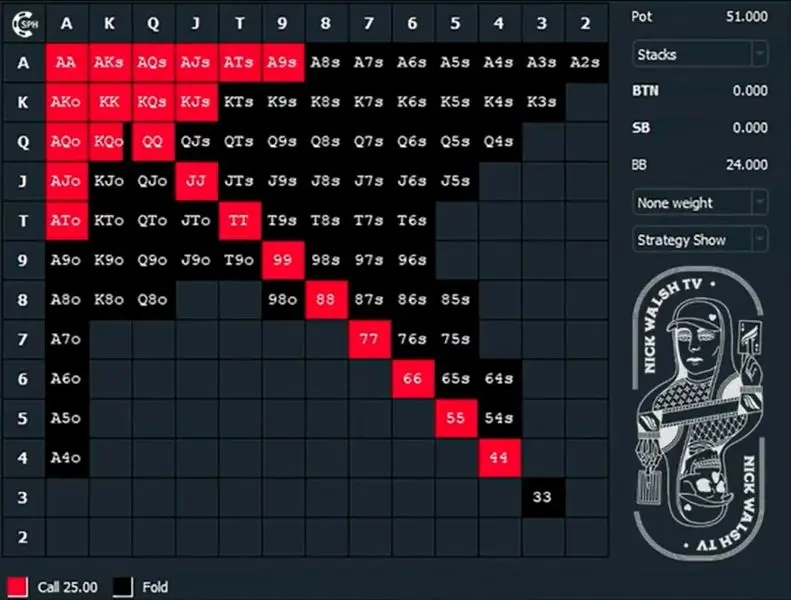
- In Spin & Gos, you’ll nearly always play for stacks by calling or raising all in with 44+/ATo+/A9s+/KJs+.
Min-Raise Folding
The stacks are very shallow in Spin & Gos, so raise-folding costs too big a portion of your stack. For example, min-raise folding with 20bb costs 10 percent of your stack. This gets even more costly as stacks get shallower.
For this reason, you can’t play too wide 3h from the button, because other players will easily be able to exploit you by three-betting or moving all in. This can lead to mountains of lost chips and be a serious leak in an aspiring Spin & Go player’s gameplay.
Of course, you will be min-raise folding some of the time even when using GTO optimal ranges. However, your ranges will be balanced so that this doesn’t become an exploitable tendency.
Calling Ranges in Spin & Gos
Certain poker hands are too strong to ever fold three-handed with the stack depths that you’ll encounter in Spin & Gos, such as the range we outlined above. Hands like medium pairs and ATo have enough equity that you can go with them every time profitably.
As stacks get shallower, you’ll call lighter to account for your opponent’s wider shoving range. For example, with 15 big blinds effective against an aggressive opponent, you would expect they are shoving very wide, allowing you to call with some additional aces and kings.
You can also make adjustments to these ranges based on your opponents. For example, against very tight opponents who never three-bet shove as a bluff, you’d consider removing the smaller pairs and A9o from your calling range. As with all GTO ranges in poker, adjusting is key to maximizing your profits, especially when it comes to reacting to other players.
25BB Effective Stacks
With the basic rules outlined, it’s time to take a look at the first preflop chart for three-handed button play. When a Spin & Go starts, effective stacks will be 25bb, making this the ideal starting point for your studies. This is the stack size for the first hand of the game and until either the blinds go up or stacks shift.
Take a look at the 25bb effective chart below. It shows the range that you should open-raise with from the button. You’ll min-raise every hand that you play at this stack depth. The range includes hands like 33+/54s+/A2s+/A5o+/K3s+/K8o+/Q4s+/96s+/T9o+.
As you can see, this is a very wide range of starting hands that includes high cards, pairs and suited hands, along with other weaker combinations. Interestingly, deuces and A2-A3o are missing from the opening range, as they don’t play particularly well postflop. You can add these back in against weaker opponents.

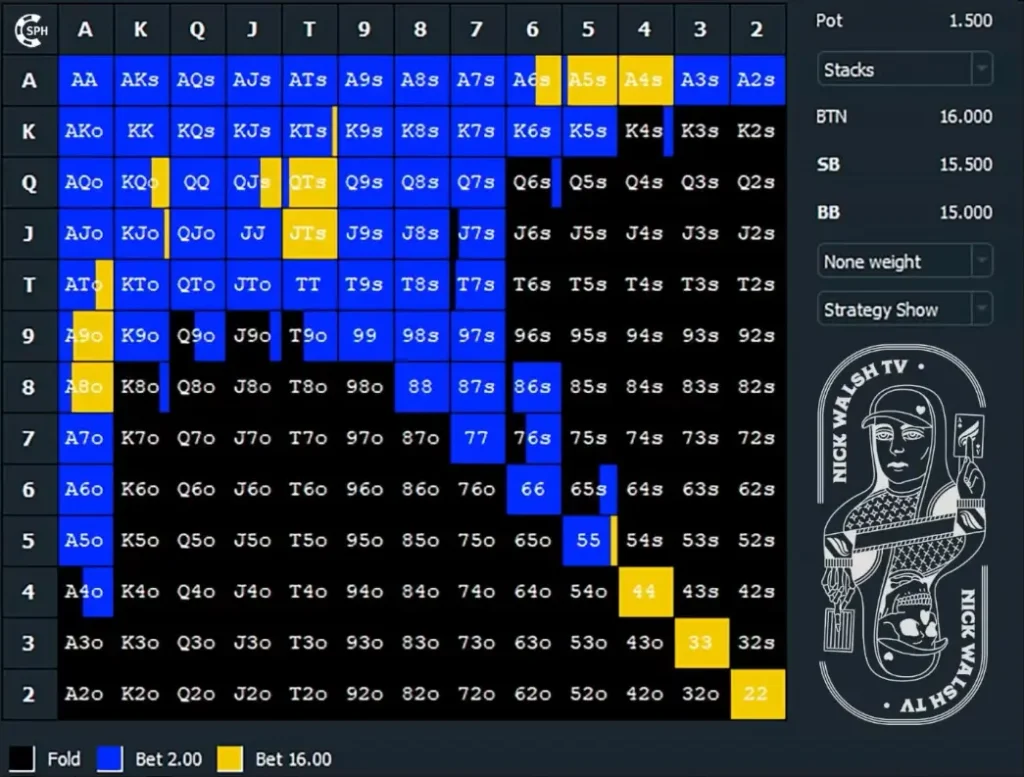
16BB Effective Stacks
At 16bb effective stacks, you’ll start to see the opening range get tighter for 3h button play. This is because of what we spoke about earlier concerning reshoves. You don’t want to be raise-folding this stack depth too often, or you’ll quickly become exploitable. So, some of the weaker hands are removed compared to the 25bb depth.
You’ll also see that the GTO chart recommends shoving some of your range at this stack depth. Hands like low pairs make good candidates, as they are often ahead preflop but lack playability postflop. Some suited aces and QJs/JTs combos can also be profitably shoved, along with medium strength aces or low suited aces.
You still have some min-raise folds here, such as with the weaker offsuit aces, which are still suitable for raising because they have the ace as a blocker. Likewise, strong suited connectors have too much playability postflop to fold, but are not strong enough to play for stacks preflop.
Take a look at the 16bb effective 3h button ranges below. As always, they can be adjusted for your opponents. For example, you can min-raise the entire range instead of shoving against players who rarely three-bet or who you can gain a greater edge over postflop.
10BB Effective Stacks
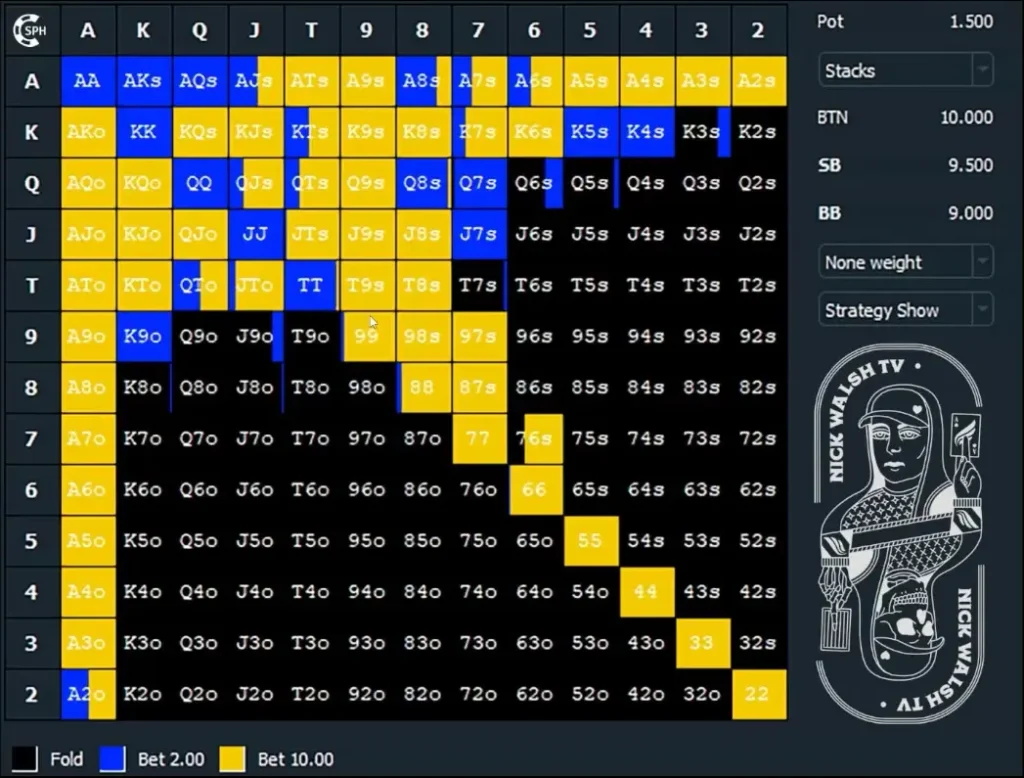
At 10bb effective stacks, the GTO solution is to open-shove most of your range. This maximizes fold equity for stealing while allowing you to gain the double up from hands with plenty of equity.
Your standard GTO shoving range at this depth includes any pair/ any ace /K6s+ /KTo+ /Q4s+ /JTo+ /87s+.
You can also min-raise some of your strongest hands, such as TT+ and Aqs+, as you want to encourage more calls and re-shoves to gain max value. To balance this, you’ll also min-raise fold a very small selection of weaker hands, such as K4s+ and Q7s+.
The chart below works well against pretty much any player, as you can’t go far wrong with GTO ranges at this depth. However, you can still make adjustments based on your opponents. For example, you might want to min-raise 99 for value against weak postflop players, or shove even wider against opponents who are overfolding.
Next Lesson…
By learning the open-raising charts above and adjusting them accordingly, you’ll soon become proficient at preflop three-handed button play. Next lesson, we’ll be breaking down preflop ranges from the small blind.





View Other Blogs