In David Sklansky’s book The Theory of Poker, he summed up the basis of poker: “Every time you play your hand differently from the way you would have played it if you see all your opponents’ cards, they gain; and every time you play the hand the same way you would have played it if you could see their hole cards, they lose.”
What if you could see your opponents’ cards after they fold? That’s the premise of Showdown Hold’em. This added layer of extra information and tweak on Texas Hold’em has benefits in both the short term and long term. After giving Showtime Hold’em a test drive, here are seven things you should consider…
1. Extra information.
Winning a hand depends upon leveraging information in real time. As you ascend the ranks of poker, the psychology of poker evolves. Premier players engage in a leveling mind game similar to the scene in the film The Princess Bride. Poker players, especially long-time adversaries, often engage in the war of “I know, that you know, that I know, that you know.” The additional information of folded hands gives Showtime an appealing twist. The additional information will either embolden what you think your opponent has, or it will convince you it’s time to fold.
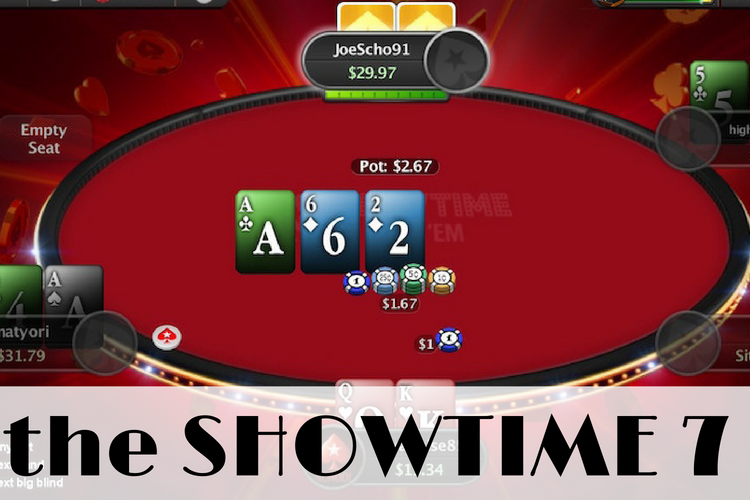
Showtime Hold’em is played 6-handed. If you get heads-up, you could see up to 4 folded hands, or a total of 8 folded cards. In a live game, a dealer might inadvertently flash a card or someone tosses their hand the wrong way and a card is exposed. It’s only happened a couple of times, but I’ve definitely folded a hand I would have played had I not seen that card. One extra piece of intel can be enough to alter your decision tree. How about eight?
Poker has no shortage of players seeking to maximize every edge, but if you can analyze situations and make quick calculations, he extra cards in Showtime will give you an advantage over your slower opponents.
2. Count those outs.
We all can’t flop the nuts. More often than not, you can ship monster pots betting that your monster draw will come in against an opponent’s unimproved made hand. Counting outs is crucial in everyday poker, particularly when assessing pot odds. The additional information of folded cards makes counting outs even more vital to success in Showtime Hold’em. Don’t forget to dismiss outs that might improve your opponent’s hand.
Sometimes you’re drawing dead preflop and don’t even know it. Showtime’s revealed cards can save you a lot of time and bets. For an avid set miner, folding pocket sevens preflop to a raise is a no-brainer if opponents folded the other two sevens.
If you are math-oriented or have problems making decisions, the extra information will be appealing. Knowing you’re drawing to slim outs is enough to sway the biggest wafflers.
3. No more fold and forget.
When you first pick up Texas Hold’em, you quickly learn it’s in your best interest to instantly forget which hands you folded. For one, you never want to give opponents in a hand free information. In a live game, when there’s two similar cards on the flop, you will often find out which player mucked trips because they cannot contain their disdain. It’s all over their faces, if they don’t outright allude to it.
At the same time, forgetting what you fold works benefits for your mental poker health. You never want to become stuck in a circular mind trap obsessing over the “pot that got away” or the hands you would’ve made if you didn’t play passively. By adhering to the axiom “Fold it and forget it!”, you can move onto the next hand.
With Showtime Hold’em, you’re forced to look at your folded cards until the end of the hand. And again. And again. And again. You cannot completely ignore the table because you hate to miss an important read on an opponent. But you have to ignore the temptation to think about what could have been. Don’t go on tilt wondering about what hands you missed. You have to pay attention to what your opponents fold/play,while avoiding the “coulda woulda shoulda” trap.
You also have to develop a thick skin and deflect any comments from opponents, who will try to tilt you in the chat with a reminder that you folded quads, or you would have rivered a gutshot straight flush to bust two players.
4. Short and long term.
Viewing folded cards in real time allows you to use that information to make in-hand decisions, but it’s also crucial data while building up a playbook on your opponent. Pattern recognition and data collection are key components to consistently winning at poker. The additional intel in Showtime helps you create a quicker blueprint of an opponent, especially when analyzing a new player at the table.
Every analyst in MI-6 and the CIA will tell you, “It’s not the info and intel that’s important, but it’s what you do with that intel.” Meanwhile, the sharpest players will figure out a way to flip the script, leverage short-term info and exploit long-term intel.
5. Just because you’re not paranoid, doesn’t mean they’re not out to get you.
Sure, you got the goods on everyone at your table. But never forget they got your number too. And if any of them are paying extra close attention, they got you totally dialed in. You can only hope that one or two players are distracted with multi-tabling and not paying attention to every hand.
Due to the constant surveillance in Showtime, you cannot play too tight or too loose because someone is paying attention and will use your hand against you.With all of your personal information in plain sight, you must to figure out a way to manipulate what your opponents see. What they think is an advantage, will ultimately become a disadvantage. Perception is crucial in poker, but deception is how you pay your bills. Pull off your own counter-intelligence operation and figure out how to manipulate any patterns your opponents picked up from your folded hands. Once your opponents have a read on you, it’s time to manipulate that image, or straight up reverse gears. Use your opponents’ analysis against them until they readjust.
6. Learning curves and sweat the best.
Learn Showtime Hold’em as fast as you can before the herd catches up! Whenever there’s a new format of poker introduced, some players will inevitably pick it up faster than others. The quicker you accelerate the learning curve in Showtime Hold’em, the bigger the edge you will have over dilettantes and other curious noobs who were left behind the curve. One of the best bankroll-building tips you can get is to develop a philosophy and playing style faster than your opponents, especially when it comes to a new form of poker.
In the 20th Century before the introduction of online poker, it could take years or even decades to master a game. Doyle Brunson was a grinder on the Texas road circuit for nearly 20 years while he sharpened his deft skills as a no-limit player, but it took an online pro like Randy “nanonoko” Lew less than a year to crush the hold’em learning curve by logging thousands and thousands of hands online in an expedited span of time.
You have to put in time at the tables to become a better player. The more hands you see, the more experience and wisdom you gain. Your quest to be a winning poker does not stop when you leave the tables. Devoted students of the game are constantly continuing their poker education through books, videos, forums, blogs, and live streams. Thanks to advances in streaming technology, beginners can watch the top players in the world play in real time with in-game commentary. Twitch has no shortage of poker-themed streams including channels from PokerStars and Team Pros such as Lex Veldhuis, Spraggy, and Jaime Staples. The best way to improve at poker is to watch better players slug it out. Sweating the action from the sidelines is both entertaining and educational.
7. Do not forget to play poker!
Showtime Hold’em is still no-limit Texas Hold’em at heart. It’s easy to lose yourself in the nuances of the new game. It’s natural to aggressively act on extra intel. But how much information is too much information? At some point, you must realize that it’s still poker. New Showtime Hold’em players might get too hung up with analyzing folded cards that they lose sight of the task in front of them — winning the pot.
Have fun with Showtime, but don’t forget to play poker!
Back to TopLatest Articles






View Other Blogs