
The EPT Barcelona short-stack bubble survival guide
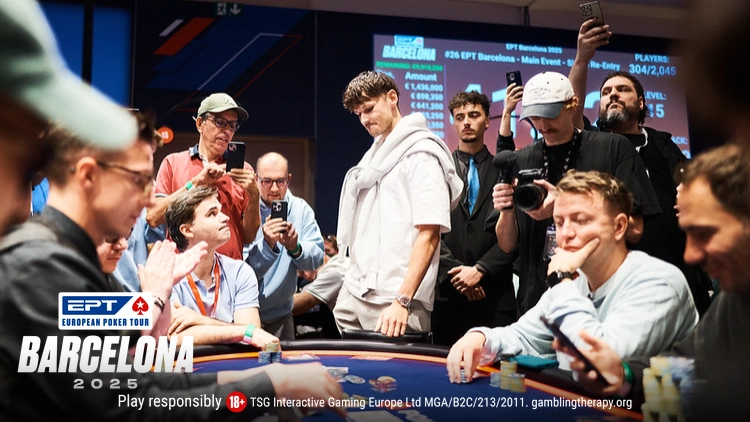
There’s a very clear message coming out of a blockbuster bubble period at EPT Barcelona: even if you’re a short stack approaching the most dramatic phase of the tournament, don’t despair.
In fact, your short stack might be some kind of indemnity against busting on the bubble.
What does this mean? Well, let’s just take a look at what happened here this afternoon.
Coming back to the EPT Main Event, there were 313 players left but only 303 due to be paid. It meant 10 players today would leave without a payout.
However, of the 15 smallest-stacked players in the room coming back today, none of them bust before the money. You read that correctly: all of the smallest-stacked 15 players entering Day 3 survived the bubble.
In fact, the first player out today, Milad Oghabian, had the 17th smallest stack coming back overnight. Amir Ghafouri, who bust in 312th, had the 18th. But the full list of players hitting the rail before the money demonstrates that having a short stack can sometimes be a safety net — while just about everyone else may be vulnerable.
Players knocked out before the money on Day 3 (and overnight position in chip counts):
Milad Oghabian (297th), Amir Ghafouri (296th), Phillip Corion (160th), Yidi Ni (143th), Luis Sequeira (279th), Hirokazu Kobayashi (128th), Rodrigo Araujo (259th), Ilia Pavlov (171st), Martins Adeniya (213th).

EPT Tournament Director Toby Stone announces the bubble
SMALL STACK = SMALL EXPECTATIONS
It’s likely all a question of expectations. If you have a tiny stack approaching the bubble, let’s say 10 big blinds or fewer, the target becomes clear: just make the money. While it would be nice, of course, to go on a crazy run of double ups and win the tournament, the more realistic ambition is just a min-cash. And so unless the table dynamics set themselves up perfectly for a speculative shove, anything short of a premium hand is getting binned.
In a drawn out and dramatic bubble period, a few of the micro-stacks did manage to double up, keeping themselves afloat. We saw kings beat queens at least once and a suited ace beat king-jack blind-on-blind, both keeping short-stacked players alive. But the real danger zone for players approaching the bubble seemed to be the 20-25 big-blind region.
As is always the case, the eliminations came in dribs and drabs. Two players hit the rail inside the first 15 minutes, then Corion’s departure, with A♣K♦ slamming into Ramon Colillas’ aces for a 300K pot, showed how vulnerable anybody could be.
THE SILENT STONE BUBBLE
There were still 305 players left when a huge pot brewed between British pro Martins Adeniya and Argentina’s Hugo Gotuzzo. They bet all the way as the dealer put the board of 8♠7♥3♥7♠7♦ out there. Adeniya bet the river, leaving himself only around 20,000 behind, and Gotuzzo shoved, with the covering stack.
Adeniya couldn’t fold and shoved his remaining chips over the line, but the floor staff instructed both players to hold their hands face down before action concluded elsewhere in the tournament room.
During this uneasy period, Adeniya looked at Gotuzzo and said, “Quads?” Gotuzzo offered the slightest of nods, but it was all Adeniya needed to see. He got up and began walking away.
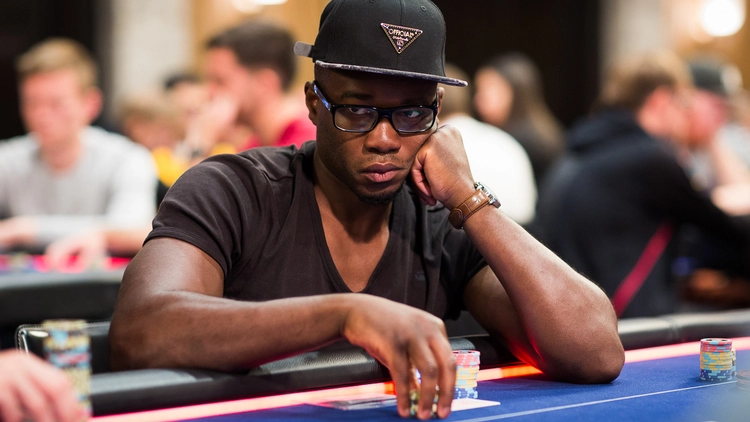
Martins Adeniya (pictured at previous event)
Despite entreaties from the floor staff, Adeniya couldn’t be halted. “I know I lose,” he said. Eventually, they did not force him to stick around so that cameras could watch his moment of pain. The floor staff tabled his A♥A♦ in Adeniya’s absence, and Gotuzzo’s 7♣6♣ took it down.
This pot turned out to be more significant than it even initially seemed.
BUBBLE-UPS AND ELIMINATIONS
Adeniya’s elimination took the tournament down to 304 players, which was the stone bubble. The next player out was supposed to be the last to leave with nothing. But it didn’t turn out like that.
On the next hand (they were now playing hand-for-hand), there were two called all-ins. Both at-risk players doubled up–sorry, bubbled up. Anton Iakuba’s A♠K♦ beat Juan Ocampo’s A♥9♠ and Sindre Hansen’s pocket 10s flopped a set to beat Ramon Munoz’s pocket jacks. (The chips went in on the flop.) The dealers dealt another hand.
This time, there were four called all-ins.
Though Paul Tait managed a bubble-up with pocket jacks against Damien Gayer’s A♠Q♥, the other three at-risk players were all knocked out. Merijn van Rooij (lead picture) lost a flip with A♠J♦, Alejandro Ganivet’s pocket kings got crushed by Albert Grane’s J♦6♦, and Robert Kaggerud also lost with kings, this time to 10♠9♠ in the hands of Tero Laurila.
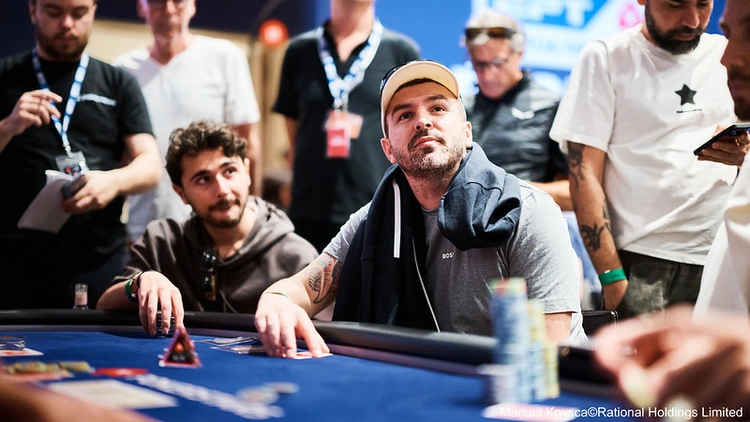
Paul Tait managed to double up on the bubble
The latter was the most dramatic. They got it all-in pre-flop and Laurila stated that he expected his suited connectors to give him a straight flush. The chuckles stopped quickly after the 8♠3♣6♠ board made the speculative prediction a distinct possibility.
The K♠ filled Laurila’s flush, but also gave Kaggerud outs to a boat. However, the Q♥ river didn’t help Kaggerud and the kings were downed. Kaggerud became the third player to bust on the bubble.
SPLITTING THE MIN-CASHES
All these knockouts happened on separate tables, which meant the three eliminated players were able to split the money for 303rd and 302nd place. All of Van Rooij, Ganivet and Kaggerud earned €5,700 apiece, which meant a profit of €400 on their €5,300 buy-in (assuming they fired only one bullet).
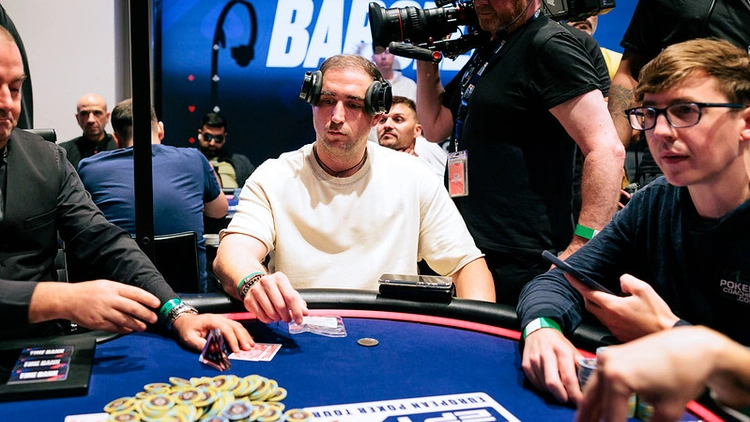
Alejandro Ganivet lost with kings
It also meant that Adeniya actually became the last man to leave with nothing, technically the stone bubble boy.
But as for those shortest of short stacks, they all locked up a min-cash at least.
MORE
Back to Top
Latest Articles






View Other Blogs