Tournament Director Toby Stone on time bank cards and stalling
A version of this article first appeared in September 2024.
The impeccable tournament management on the European Poker Tour (EPT) does not happen by chance. Although the tournament team is full of experienced professionals, it is still always a work-in-progress. Tournament officials listen to problems, make changes, and address any issues that may arise.
The intention is always the same: to make everything run as smoothly and fairly as possible, allowing players to enjoy playing on the EPT more than anywhere else.
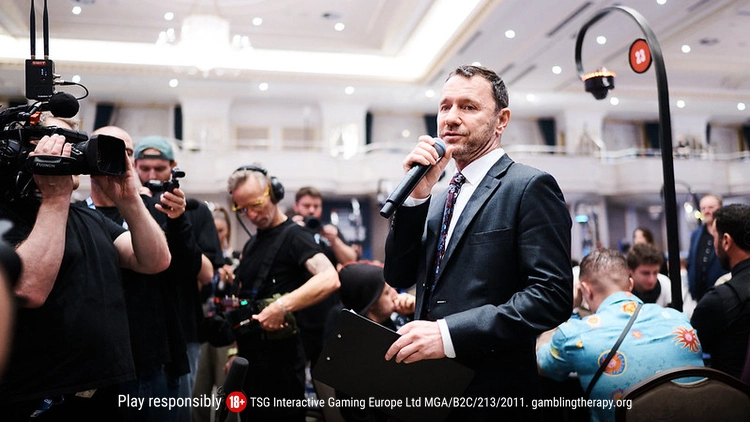
EPT Tournament Director Toby Stone is always willing to share insight on latest improvements his team have made to keep events ticking over in the best, fairest way possible. In a number of interviews, he delves deep into some of the key issues affecting the game at the moment.
In the first part below, Stone focuses on the always thorny issue of stalling in tournaments. According to Stone, this is by no means a major issue for the tournament staff, but it’s an area that tends to be brought up time and again by players who insist that a solution is implemented.
There is, of course, no silver bullet that would instantly make the problem go away. But the introduction of shot clocks and time bank cards has helped, with Stone revealing how recent discussions have focused on the number of cards allocated to each player, and when they are distributed. He also speaks about a change in procedure at final tables, where the clock is abandoned entirely in favour of a hands-per-level process.
Here’s an edited version of two interviews, which took place in Barcelona 2024 and Monte Carlo 2025.
TIME BANK CARDS — HOW MANY, AND WHEN TO GET THEM?
The EPT introduced shot clocks a few years ago, limiting players’ decision-making time to 30 seconds on each street. They also get a number of time extension cards, allowing them to request an additional 30 seconds thinking time if a situation demands it. Ever since, the question of how many cards each player should get in various tournaments has caused a few headaches.
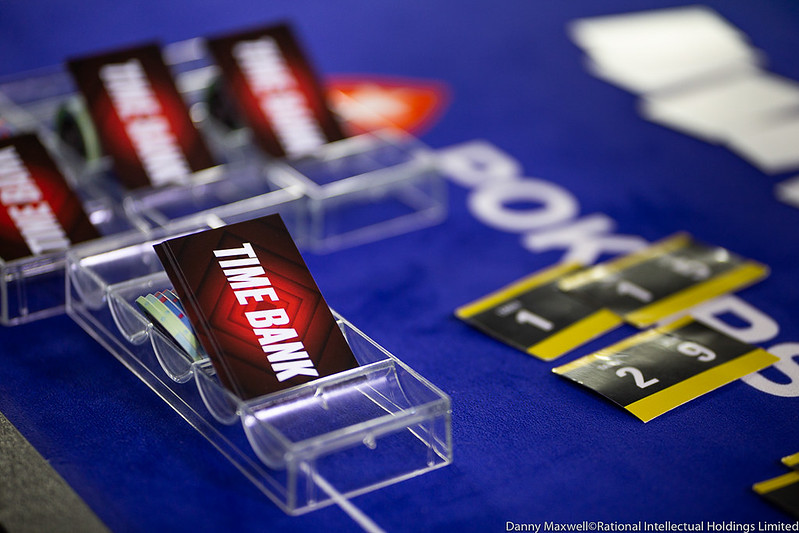
Time bank cards in action
Stone says: The problem with time bank cards was that it was quite confusing. We had different tournaments, different number of cards, sometimes we gave them on a new day, and sometimes we gave them on the final table. Sometimes the final table was the new day, so do we give them, do we not give them? Floor staff were coming up to me all the time, “How many is it for this one? And how many is it for this one?” And even I didn’t know.
So we’ve completely simplified that now. So we’ve got different tournaments that use time bank cards, including EPT Main Events from Day 3. And in the Main Event, you just get six every day. It doesn’t matter how many players they’ve got. It doesn’t matter when they hit the final table. It’s just six every day, from Day 3. That’s quite simple.
Then we’ve got €10K-plus events, which get them from the beginning. What we do there is, we give four or six at the start. And then you get one every two hours, and that’s it. It doesn’t matter what kind of tournament it is, it’s just the same. The only difference is four or six at the start.
SLIGHTLY DIFFERENT TIME BANK FOR HIGH ROLLERS
In the €25K-plus events, players get six because they have told me they need a bit longer to make their more complicated strategy decisions. They need a bit more. That’s fine. We listen to them.
We used to give six cards in all tournaments, but then in Paris in 2024, we gave six [at the beginning] in the €10K High Roller, plus an additional card per hour. We used to give six and one per hour. What happened is that just before the bubble so many people had, like, 20 or 25. So we were giving too many. And obviously the more time banks we have, the more risk there is of stalling. And it’s already a problem, and we were just making it worse.
So we’ve changed that. Now they get four and they get one every two hours, which is probably what you need.
We were thinking that maybe we’d say you can have so many, up to a certain amount. But how do you manage that? You’d have to go round and count them all. So we’ve looked for some solutions but the only solution we’ve found is just give them less.
FURTHER AMENDMENTS
As a direct result of player feedback ahead of EPT Monte Carlo 2025, shot clocks were introduced in some tournament formats at Level 11, with players receiving two 10-second time bank cards at the start of that level. A further two cards are issued to players at the next break, with a maximum of four time bank cards given out in most tournaments.
Updated feedback suggests the 10 second countdown is marginally too quick. This is going to be modified to 15 seconds going forward. It’s not a big change at all, but just demonstrates again how quickly the EPT team will react to informed feedback.
IS STALLING STILL THE BIGGEST PROBLEM?
It’s not a problem for me. It’s the players’ tournament, they’re losing the time.
But it is a pain in the ass. The players start to complain. They give out to us. They see it as our problem, saying: “You have to fix this!” The floor gets called all the time and it just creates a mess. And what can we do, apart from limit the amount of time they have? Limit the amount of time bank cards they have, limit the amount of cards they can use in any one game.
That’s all written in the SOP [the standard operating procedure, essentially the terms and conditions of play on the EPT]. I put in every SOP, “We, at any time, can limit the amount of time banks you have or limit the amount of time.” So if we feel someone is unnecessarily stalling and disrupting the game, then we can address that player.
It’s fine in the €25K events. Those players don’t really mind. To them, it’s all OK, they all do it, it’s all part of the strategy. It gives them a little bit of edge and they all do it. So for them it’s not a really big issue. It’s for all the other tournaments. So we have that in the SOP and we do use it sometimes if we feel it’s the right thing to do.
The problem is that we get some very big tournaments. There could be 15 tables and you nearly have to put one person on every table watching every player. Once you’ve told one person that they’re not allowed to use any more time bank cards, or that they are only allowed 10 seconds, you’ve got to stand over that person to make sure that it doesn’t happen.
WHAT DO YOU TELL DEALERS? DO THEY FLAG STALLING?
To a degree, yes. But we don’t want them to be the policemen at the table on that issue because it wouldn’t create a nice atmosphere between the dealers and the players. We try to make that a floor call. So the dealers are not supposed to be calling out, “This person’s stalling!” That’s really up to the players, to notify us that’s what a player is doing.
But then, if we were called to a table two or three times — there has to be a limit — for the same person, then we might have a word with them. We’d say, “Look, sir, it really looks like you’re stalling. You’re wasting time in the tournament, so we’re going to reduce the time you have to act.”
If they start to play properly, at a reasonable pace again, we’ll walk away. But if they continue, we’ll reduce their time and we’ll just keep reducing it. So if we reduce it to 15 and they take the full 15 seconds, and then again take the full 15, we’ll reduce it to 10. Then we’ll reduce it to five.
It’s a pain, because imagine trying to do that with six, seven, eight or 15 people! We can only make our best effort.
YOU SOMETIMES GO HAND-FOR-HAND A LITTLE EARLIER IN SOME EVENTS THAN IN OTHERS. WHY?
If an event is being televised — i.e., they’re making a TV show as well as the live stream — it’s vital for the TV that they see the bubble hand.
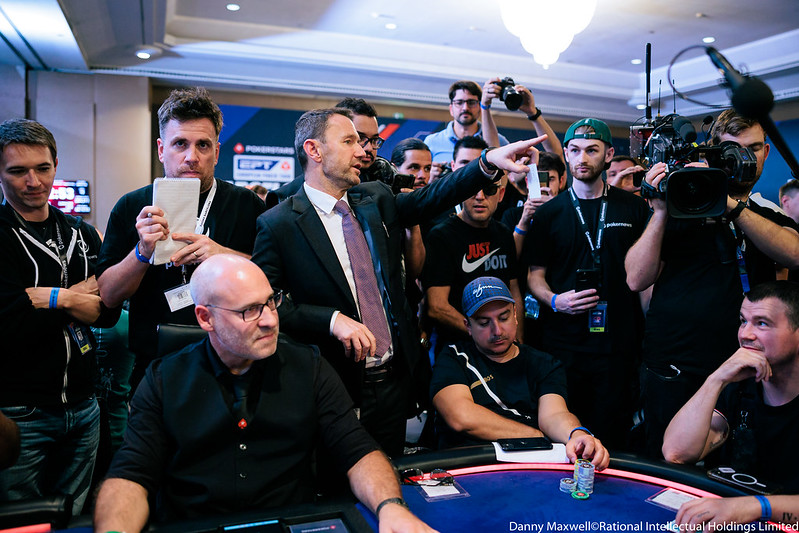
Busy times in Barcelona
Sometimes you get two or even more people knocked out on the same hand, so the bubble can burst without any need for hand-for-hand play. And when it’s on the stream, that doesn’t matter. They don’t have to film that precise hand. They’ve got cameras out there trying to catch what they can catch, so we can go right to the line. But when it’s televised, they have to get the exact hand.
Sometimes we go hand for hand early because just no one is playing and we can’t police it, we can’t stand over every person. But I very rarely go early. For me, the bubble is the bubble.
MORE ABOUT THE HANDS-PER-LEVEL PROCESS
A traditional tournament schedule has the blinds going up at the end of set period of time. The EPT Main Event, for example, has levels that last either 60 minutes (on Day 1) or 90 minutes (thereafter), but various tournaments have blind levels of various durations, all the way down to five-minute levels in so-called “super hyper turbo” events.
However, a rule change brought in in Monte Carlo in 2025 amended this process when the tournament reached its final. Instead of a timer, a level ends when players have played a certain number of hands.
In the EPT Main Event, a final table level will last 30 hands. In the High Roller and Super High Roller, which used to have a 60-minute clock, a level will last 24 hands. Different tournaments have different numbers, all the way down to those super hyper turbos, where final table players will see four hands before the blinds go up.
As ever, there was a good reason for the change.
“Some players had brought this up to me towards the end of last year,” says Stone, explaining that some players and tournament supervisors had observed players deliberately stalling at the table to ensure a specific opponent pays a bigger big blind.
If, for instance, there are two short-stacked players at a final table, one might want to make sure that the other has to pay as big a value of big blind as possible. If there are only a couple of minutes until the end of the level, and that opponent will soon be in the big blind, the player could fake having a tough decision to make, wind the clock down, and ensure they reach the end of the level before the button is moved.
The new rule “prevents people from stalling to make other people pay a bigger blind,” Stone says. “That’s something I really don’t like.”
Stalling is very often the reason behind recent rule changes, and though it was the specific prompt for this one, Stone says that the amendment has had a couple of unexpected benefits too.
“You can strategise more now, because you know now how many hands you’re going to play,” he says. “This came from player recommendation and our team wanting to prevent people making someone else pay a big blind. The additional benefit of that is that players can strategise better.”
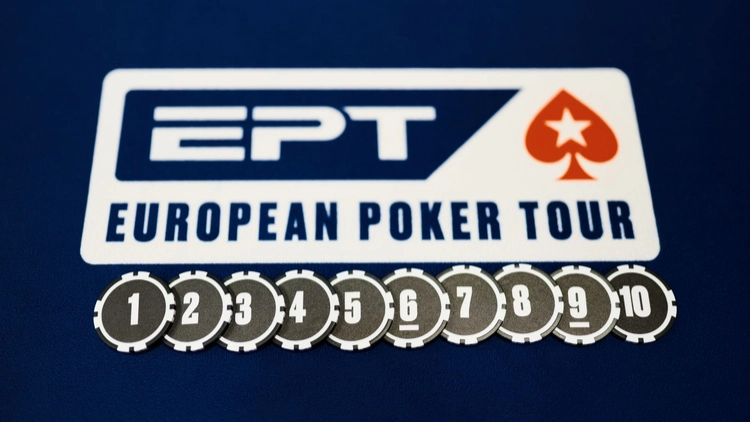
He adds that it also helps organisers structure tournament breaks because they can basically be taken mid-level without any discernible impact on gameplay. The number of hands dealt is tracked via numbered chips kept in the dealer’s well, visible to all players at all times. So if the tournament goes on break, rather than having to pause the clock, the dealers can just keep the same chip visible and players can come back and start right up again.
Stone had intended to implement the change at EPT Paris in early 2025, but the event’s cancellation meant we had to wait until Monte Carlo for the rollout. “I did want to bring it in in an EPT rather than a regional event,” Stone says, adding that it’s necessarily a work in progress, as his team track the relative speed of tournaments, plus garner player feedback.
He methodically figured out how many hands he should allocate per level, based on existing level length and the average time it takes to play a hand. But tournament staff recorded the data in Monte Carlo, giving an even greater cache of information with which to make any necessary amendments before the next events.
As we approach EPT Barcelona 2025, we’ll check back in with Stone to learn how many hands will now be played.
Read Part II of this interview, on the subject of technology.
Back to Top
Latest Articles






View Other Blogs