EPT Prague: Tournament mechanics explained: When is a bubble not a bubble?
Three out at once at EPT Prague. So who bubbles? Here's an explainer on what happens when there are multiple eliminations on the bubble.

As the bubble approaches in major poker events, tournament directors grab the mic and give a clear and well-practised announcement. It goes something along these lines:
“If two players bust from the same table on the same hand, the player with the fewest chips is the bubble. If two or more players bust from separate tables on the same hand, the prize money for xxth place is split.”
This is an important area of tournament mechanics, which had a very clear relevance at the EPT Main Event in Prague last night.
Here’s the explanation of what it means.
WHAT’S THE BUBBLE?
The prize pool in poker tournaments is split between the players who last the longest. The winner gets the biggest prize, but it’s not winner-takes-all. Instead, the top portion of the field — typically 12 to 15 percent — gets a payout on a sliding scale.
At EPT Prague this week, for instance, the top 184 finishers from a 1,224-entry field, were guaranteed a payout. The player busting in 184th was due to get €8,350, otherwise known as a “min-cash”. After that, every remaining player would get some prize money on elimination, with that prize gradually getting bigger the longer the player lasted.
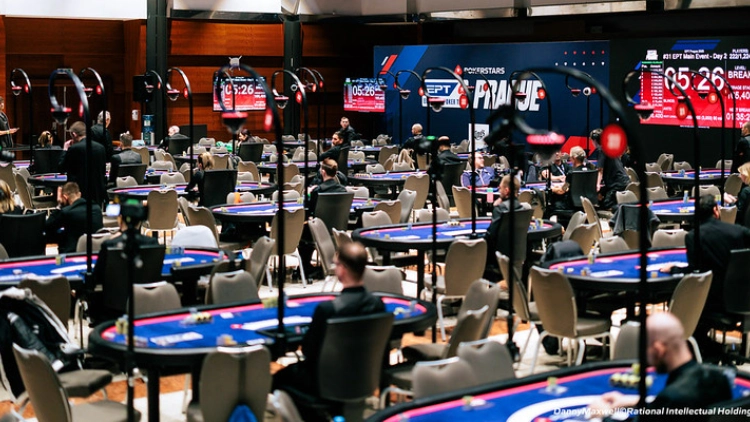
The more tables there are, the more complicated the bubble is
On the flipside, the player busting in 185th would get nothing.
It means that there’s always a very tense moment in a tournament: the point where the next player out “bursts the bubble” and the remaining players are all “in the money”, sometimes known as ITM.
HAND-FOR-HAND PLAY
Given the significance of the bubble, it follows that players do everything they can to avoid being knocked out the wrong side of the bubble. Very often, play slows down considerably as players “stall” (i.e., delay the action) in the hope that players on different tables are knocked out instead of them.
One method of combatting this and keeping everything fair is “hand-for-hand play”. This is where the tournament floor staff essentially freeze the natural flow of the tournament and instead instruct dealers to only deal one more hand at a time, in co-ordination with all the other tables in the room.
No subsequent hand is dealt until play is finished everywhere. Everyone sees the same number of hands, no matter how long they take to play out. It eliminates the effectiveness of stalling since no one is seeing any more hands than anyone else, and no one is paying any more blinds than anyone else.
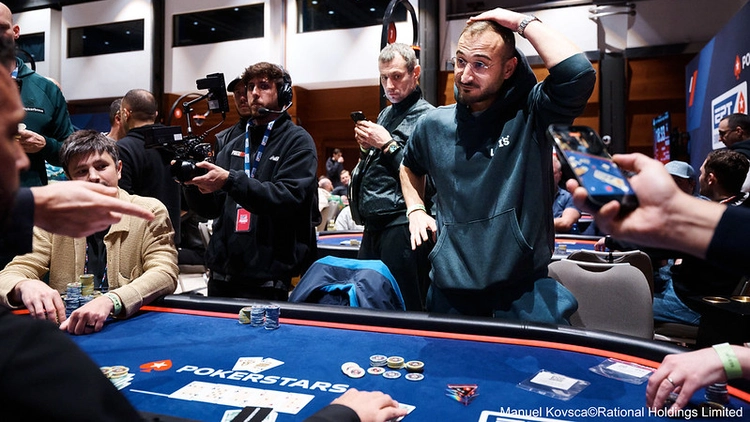
Gal Naim was one of three players knocked out on the same hand
Floor staff will instigate hand-for-hand play when the bubble approaches. Most often, it will be when only one more player needs to be knocked out to reach the ITM stage — otherwise known as the “stone bubble”. But sometimes, and especially in really big tournaments, hand-to-hand play will come into operation several more places off the money. This is known as the “soft bubble”.
This approach is also useful in that it allows staff to follow precisely how many players are still seated. They can track each and every elimination and can accurately inform players how many spots away from the money they now are.
MULTIPLE KNOCK-OUTS
It’s usually at the point of instigating hand-for-hand play that tournament directors make the announcement above. Play is now operating across all tables at the same pace, and that means it’s possible to determine exactly when a player is knocked out.
This brings in the potential for what in other sports might be called a dead heat. If Player A on Table 1 is knocked out on the same hand as Player B on Table 2, they’ve essentially tied. While this doesn’t matter at any other pre-bubble stage of the tournament, it’s very relevant when the field is at this crucial stage.
The established practice, therefore, is that two or more players getting knocked out simultaneously on different tables will share the smallest cash.
In Prague last night, it wasn’t just one or two players who were knocked out on the same hand, however. After a protracted bubble period, during which numerous players doubled up when under threat, three players then got knocked out on three different tables on the same hand.
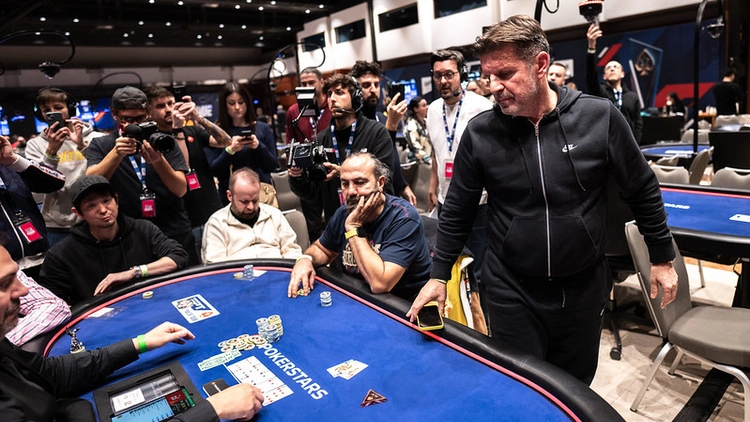
Slobodan Ruzicic also perished on the bubble
It followed that Slobodan Ruzicic, Gal Naim and Nusret Atmaca were all knocked out in a tie for 184th place, which should have been the stone bubble position. They all both “bubbled” the tournament and all min-cashed, and the tournament was left with 181 players when they had departed.
These three therefore split the prize money for both 183rd (€8,350) and 182nd (€8,350) position. They therefore divided €16,700 three way and ended the tournament with €5,565 each.
From a tournament with a buy-in of €5,300, they made only a very modest profit (assuming only one buy-in each). But it’s better than ending with nothing.
THE EXCEPTION TO THE RULE
It’s not impossible, of course, for a poker hand to result in two eliminations on the same table. In fact, multiple knockouts happen quite often, let’s say if a short-stacked player shoves in early position, and two opponents with bigger stacks both also commit their chips.
If the player with the bigger stack wins the pot, the two smaller-stacked players are eliminated at the same time. In this instance, the player with the bigger stack of the two eliminated players is considered to have finished higher up the payout ladder than the shorter stack. In this was on the bubble — and remember, this is strictly when multiple knockouts occur at the same table — the shorter-stacked player will therefore be stone bubble and get nothing. The bigger-stacked player would get the min-cash all to themselves.
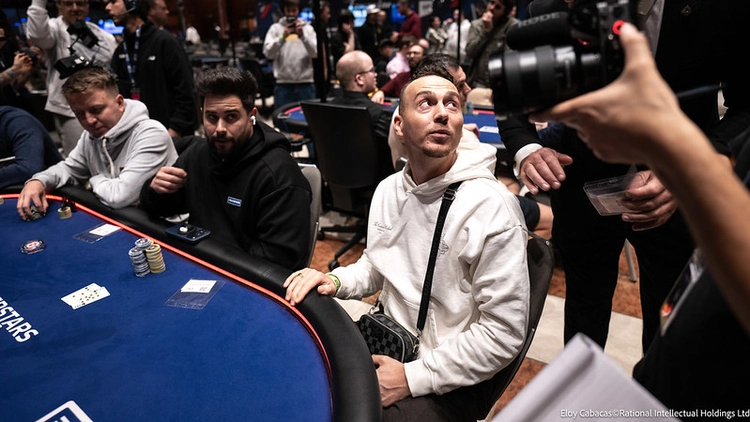
Nusret Atmaca followed the other two out the door
In some extraordinary circumstances (not common, but definitely possible), three players might get knocked out simultaneously, with two of them on the same table and the other on a separate table.
In that instance, the player with the shorter stack from the double elimination table would be the stone bubble. The other two would split the min-cash.
It might seem harsh, but those are the rules. And it’s why the tournament director gives all the players that reminder just before it potentially happens, so there are no nasty surprises for anyone.
SO WHO BUBBLED IN PRAGUE?
Although the three players mentioned above officially burst the EPT Prague Main Event bubble, let’s spare a thought this morning for David Vesely.
The Czech player got around 30 big blinds in the middle shortly after hand-for-hand play began, most of it heading into the middle after a flop of 9♥10♥7♦. Veseley had K♣K♥ and was in good shape when his opponent Ivan Deyra tabled A♠J♦.
Deyra still had the dangerous ace in his hand, but it was actually the 8♠ on the turn that was the real hammer blow to Vesely. Deyra filled an inside straight, leaving Vesely drawing dead.
Vesely didn’t know it at the time, but he would be the last player to leave the EPT Prague Main Event without a payout. A bubble but not a bubble.
MORE
Back to Top
Latest Articles





View Other Blogs