Donk-Betting on Low Paired Flops
Donk-betting means betting out of position as the caller of a pre-flop raise before the raiser has had a chance to act yet.
While donk-betting was once seen as a weak play, modern poker strategy shows it can be a strong way to counter your opponent’s positional advantage on certain board textures.
Why You Don’t Usually Donk-Bet
Normally speaking, donk-betting is unsound and unnecessary. In fact, one hallmark of a weaker recreational player’s game is his tendency to donk-bet in all kinds of situations. This is usually misguided because as the big blind caller, your range will be at a disadvantage to the in-position raiser’s range. This means that you will very often want to check to keep the pot smaller and will need to protect this checking range with your better hands. Check/raising a set is a great idea because you trap a bet in there first from a very wide range and then get to pile in more chips. If you led out with all of your good hands, your checking range would be far too weak and you would be folding to c-bets almost always.
The pre-flop raiser will want to bet a lot with his stronger range to force you to fold out hands with some equity that are too weak to continue. If Villain is going to bet very frequently anyway, then it does not make a lot of sense to donk bet.
That said there are sometimes when building a donk bet range actually makes sense.
Donk-Betting and EV
In game theory, when you input a range for each player and a flop, a solver will generate the overall EV (expected value) of each player’s range. If the starting pot on the flop is $60 for example, then the EV of each player will add up to $60. They two opposing ranges are fighting over this amount of money. The reason that the big blind caller does not want to increase the size of the pot by donking out is that his range often has a very low EV. On flops that do not help his range, they may only be entitled to $20-$25 of the pot. However, there are some flops that are very favourable for the BB caller.
Which Flops Can You Donk?
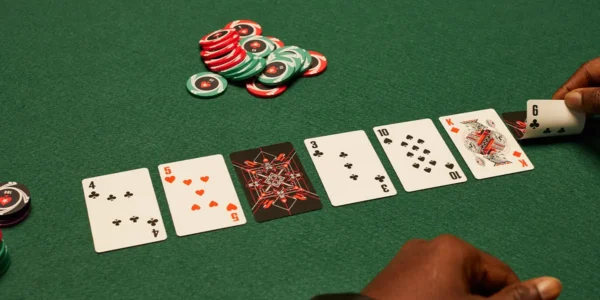
These are boards where the pre-flop raisers overpairs have been devalued, namely where some sort of low trips is possible. If you think about it, the big blind will have more nutted combinations than a HJ opener on these flops due to playing more of the low trips-making card pre-flop than the opener does. Having lots of nutted hands (trips) drives up the EV of the out of position player and on a flop of 6♥6♦4♦, they can approach or even exceed 50% of the pot’s EV depending on ranges.
This means that if checked to, the HJ raiser will want to check back quite often to keep the pot small. His overpairs are not so happy to shovel money in on this flop and they will want to check behind with a lot of ace-high too.
You can counter this plan by building a polarised donk-betting range to ensure that the pot gets the chance to grow when you’re holding trips or a vulnerable overpair that does not want to allow Villain to see the turn for free. You can balance this by also leading some draws and backdoor draws as a bluff.

How to Build the Donking Range?
The hands you want to donk-bet on these low paired boards fall into four broad categories.
- Trips – Donking betting these ensures pot growth and deprives Villain of the chance to pot control when you are holding the nuts. By putting some money in right now, you make the pot bigger on the turn which leads to an exponentially bigger pot by the river than would be possible if the flop was to go check-check.
- Vulnerable overpairs and pairs on the board – Leading out with hands like TT and 99 on a flop like 5♠5♦3♠ makes a lot of sense. You get to protect these vulnerable hands from overcards falling on the turn. If Villain wants to call KQ against a small bet, then great, you get value; and if they would rather fold, then awesome – you protect your equity and win the pot 100% of the time instead of 75%.
- Flush Draws – There is absolutely nothing wrong with increasing the pot-size with a hand that is drawing with many outs to something strong. Flush draws; needless to say; are the most powerful semi-bluffs available here. While you will not always want to lead with a draw, you will often donk-bet ones with high nut potential and limited showdown value like A5s with a flush draw or K2s.
- Weaker Bluffs – Theoretically, it is also important to donk-bet on these low paired boards with some draws that do not make the nuts on a flush-card turn. You want to be able to bluff flush run-outs sometimes so not all of your bluffs should be drawing to the flush. Backdoor flush draws, gutshots, and open-end straight draws make fine candidates for adding a bit of variety to your bluffing range. However, since these hands are so weak, you will have to be careful not to add too many of them to your bluffing range in the long-term against an astute opponent.
When implementing a leading range, keep your sizing on the smaller side (25–33% pot) to put pressure on your opponent’s marginal hands.
Summary
- It is strategically unsound for the big blind caller to donk-bet on most flops.
- Because the BB’s range usually has low EV, he should normally start by checking his whole range.
- On low paired flops the BB’s range might catch up and have good EV. It is on these flops that he can start building a donk-betting range.
- A donk-betting range should be polarised and consist of trips and overpairs, or on the other hand, flush draws and weaker bluffs from time to time.
- Have fun donk-betting low paired flops, but don’t apply the ideas in this article this on any other type of flop where your range is very weak.



View Other Blogs