Understanding House Edge Across Different Casino Games
Every casino game is built around probability. Whether you are playing blackjack, watching a roulette wheel spin, choosing a slot or placing a baccarat bet, the possible outcomes and their payouts determine the mathematical advantage held by the casino.
That advantage is known as the house edge.
House edge is usually expressed as a percentage and represents the casino’s theoretical advantage over players across a very large number of bets. However, the percentage isn’t the same for every casino game. It can even vary within the same game depending on the rules, payouts or type of bet being made.
Understanding house edge therefore isn’t about finding a way to beat a casino game. Instead, it provides a useful way of understanding the mathematics behind different games, why casinos have an advantage and why seemingly small changes to rules or payouts can alter that advantage.
In this guide, we’ll compare the house edge across popular casino games including blackjack, roulette, slots and baccarat, while looking at some of the factors that cause the percentages to differ.
What Is the House Edge?

The house edge is the mathematical advantage a casino has over a player in a particular game or wager.
For example, imagine a hypothetical casino game with a house edge of 5%. In mathematical terms, that means the casino’s expected return is equivalent to 5% of the total amount wagered over a sufficiently large number of plays.
If $100,000 were wagered on that game over time, a 5% house edge would correspond to a theoretical casino advantage of $5,000.
That doesn’t mean someone who wagers $100 should expect to lose exactly $5.
Individual gambling sessions can produce results that are very different from the theoretical house edge. A player might win, lose considerably more than 5%, or finish close to where they started. House edge describes a long-term mathematical expectation rather than predicting what will happen during a particular session.
The larger the number of bets considered, the more relevant the underlying probabilities become. This is one of the reasons casinos can offer games where individual players sometimes win while still maintaining a mathematical advantage over the long term.
Why Do Casino Games Have a House Edge?
Casinos need a mathematical advantage for their games to be commercially sustainable.
That advantage is generally created through the relationship between the probability of an outcome and the amount paid when that outcome occurs.
Imagine a simple game based on a fair coin toss. There is a 50% chance of heads and a 50% chance of tails. If a $1 winning bet returned $1 in profit and a losing bet lost $1, neither side would have a mathematical advantage.
Change the payout, however, and the calculation changes.
If the casino paid less than the mathematically fair amount when the player won, the casino would gain a theoretical advantage over repeated plays. Casino games use considerably more complicated probability models than this example, but the basic principle remains the same.
The way that advantage appears differs between games.
In roulette, the presence of the zero pockets affects the probabilities behind many bets. In baccarat, different possible wagers have different probabilities and payout structures. Slots use predetermined mathematical models that determine their theoretical return to player (RTP). Blackjack is more unusual because its house edge can vary according to the rules being used and decisions made during play.
That is why referring to “the casino house edge” as though it were one universal percentage can be misleading. There is no single house edge applying to every game in a casino.
House Edge vs RTP: What’s the Difference?
House edge and return to player (RTP) describe closely related concepts from opposite perspectives.
House edge represents the casino’s theoretical advantage, while RTP represents the theoretical proportion of wagered money that a game returns to players over the long term.
In a simplified example, a game with an RTP of 96% has a corresponding house edge of 4%:
100% – 96% RTP = 4% house edge
Again, neither figure predicts the result of an individual session.
A 96% RTP does not mean that every $100 wagered will return $96 to that particular player. The percentage is calculated across a very large number of game rounds and is a theoretical long-term figure.
RTP is particularly common when discussing slot games, whereas house edge is frequently used when comparing table games and individual casino bets.
Both figures are ultimately ways of describing the underlying mathematics of a casino game.
Blackjack House Edge
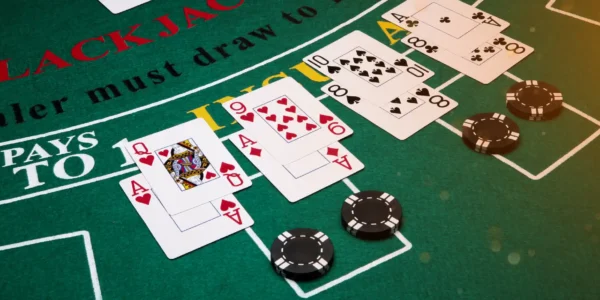
Blackjack is slightly different from games such as roulette because there isn’t one house edge that applies to every version of the game.
The mathematical advantage can change according to the rules at the table, including how much a blackjack pays, the number of decks being used and the actions permitted after the initial deal.
Player decisions also form part of the mathematics. Unlike roulette, where placing a bet doesn’t affect which number the ball lands on, blackjack requires players to make decisions after seeing their cards.
For that reason, published blackjack house edge figures generally depend on a particular set of rules and assumptions about how the game is played.
Under favourable rules and mathematically optimal play, commonly quoted figures can place the blackjack house edge at around 0.5%, although the actual percentage varies between games.
Why Blackjack Payouts Matter
One of the clearest examples is the payout for receiving a natural blackjack.
A traditional blackjack payout is 3:2. A $10 winning blackjack at 3:2 therefore produces $15 in winnings.
Some tables instead offer 6:5 blackjack payouts. Under that structure, the same $10 blackjack produces $12 in winnings.
The probability of being dealt the blackjack hasn’t changed. What has changed is how much the player receives when it occurs.
That lower payout increases the casino’s mathematical advantage. Moving from a 3:2 to a 6:5 blackjack payout can add roughly 1.4 percentage points to the house edge, although the exact overall edge still depends on the other rules in use.
How Blackjack Rules Affect House Edge
The blackjack payout is only one variable.
Number of decks: Blackjack can be played using anything from a single deck to a shoe containing several decks. All other things being equal, additional decks can slightly increase the house edge.
Dealer hits or stands on soft 17: A soft 17 contains an Ace being counted as 11, such as Ace-6. Some games require the dealer to stand, while others require them to take another card. A rule requiring the dealer to hit soft 17 generally increases the house edge compared with the dealer standing.
Doubling rules: Casinos can differ over which hands players are permitted to double down on. More restrictive doubling rules can affect the game’s mathematical edge.
Doubling after splitting: Some versions allow players to double after splitting a pair, while others do not. Allowing it generally produces a slightly lower house edge.
Surrender: Certain blackjack games allow a player to surrender eligible hands and lose only part of their original wager rather than completing the hand. Its availability can also affect the overall house edge.
These differences can accumulate. Two blackjack tables might look virtually identical while operating with different mathematical advantages because their rules aren’t quite the same.
Does Blackjack Strategy Change the House Edge?
This is where blackjack’s house edge requires slightly more explanation.
The probability of future cards isn’t changed by a player’s decision, but choosing whether to hit, stand, double or split determines which possible outcomes they expose themselves to.
When a blackjack house edge is quoted based on basic strategy, the calculation assumes that each decision is made according to a mathematically derived set of actions for the particular rules being used.
Playing differently can result in a higher effective house edge.
Basic strategy does not remove the casino’s mathematical advantage, nor does it predict whether an individual hand will win or lose. It simply provides the decision-making assumption used when calculating many published blackjack house edge figures.
This distinction is particularly important when comparing blackjack with games where players have no decisions to make once a wager has been placed.
Roulette House Edge
Roulette has a more fixed house edge than blackjack. There are no decisions to make once the wheel starts spinning. The main factor is the type of roulette wheel being used.
The biggest difference is the number of zero pockets.
A standard European roulette wheel has numbers 1 to 36 plus a single zero. American roulette has the same numbers but adds both 0 and 00.
Those extra pockets change the odds and increase the house edge.
European Roulette House Edge
European roulette has 37 pockets in total. These are numbers 1 to 36 plus a single zero.
Most bets have a house edge of around 2.70%.
Take a bet on red or black as an example. There are 18 red numbers and 18 black numbers. However, the green zero belongs to neither group.
This means a bet on red has 18 winning outcomes but 19 losing outcomes.
The zero might seem like a small addition to the wheel, but it is what gives the casino its house edge on these bets.
The same 2.70% house edge applies to many other standard European roulette bets. This includes single numbers, dozens and columns.
American Roulette House Edge
American roulette adds a second green pocket, 00, bringing the total number of pockets to 38.
There are still only 18 red numbers and 18 black numbers. A red or black bet now loses when either 0 or 00 appears.
As a result, the standard house edge on American roulette rises to around 5.26%.
The payouts for most bets are the same as they are in European roulette. For example, a winning bet on a single number still pays 35:1.
However, there are now more possible outcomes. This is why the extra zero makes such a big difference to the roulette house edge.
French Roulette House Edge
French roulette usually uses the same 37-number wheel as European roulette. However, some versions include special rules that can affect certain bets.
One example is La Partage.
This rule can apply to even-money bets such as red or black, odd or even, and high or low. If the ball lands on zero, the player receives half of their original stake back instead of losing the full amount.
When La Partage applies, the house edge on these bets falls to around 1.35%.
Another rule you may see is En Prison. When zero appears on an eligible even-money bet, the wager can remain in place for the next spin instead of being immediately lost.
The exact rules can vary, so French roulette does not always have the same house edge on every table.
European vs American Roulette House Edge
The difference can be shown simply:
| Roulette version | Number of pockets | Typical house edge |
| European roulette | 37 | 2.70% |
| American roulette | 38 | 5.26% |
| French roulette with La Partage* | 37 | 1.35% on eligible even-money bets |
*The 1.35% figure only applies when the La Partage rule is available and applies to the bet being made.
This comparison shows how one small rule change can affect the maths behind a casino game. American roulette only adds one extra pocket, but the standard house edge is almost twice that of European roulette.
Slot House Edge

Slots work differently from table games such as blackjack and roulette.
There is no single house edge that applies to every slot. Each game has its own mathematical setup. This includes its return to player (RTP).
RTP is usually the easiest way to understand the house edge of a slot.
If a slot has an RTP of 96%, its theoretical house edge is 4%.
100% – 96% RTP = 4% house edge
If another slot has an RTP of 94%, the house edge is 6%.
These figures are based on a very large number of spins. They do not mean a player will get $96 back every time they wager $100 on a slot with a 96% RTP.
Why Do Slots Have Different RTPs?
Slot RTP can vary from one game to another.
This is because each slot has its own rules, payouts and probabilities. The value of different symbols, the chance of forming winning combinations, and the features within the game can all form part of its mathematical design.
Some slots may also be available with different RTP settings. This means two versions of the same slot could have different theoretical returns.
The RTP displayed for the version being played is therefore more useful than assuming all slots from the same developer or series have the same house edge.
How Is Slot RTP Calculated?
Slot RTP is based on all the possible outcomes of the game and how much each winning outcome pays.
Modern online slots use a random number generator (RNG) to determine the outcome of each spin. Each spin is independent of previous results.
The game’s underlying maths then determines its theoretical RTP over a very large number of spins.
For example, imagine a slot has a theoretical RTP of 96%. Across a large enough sample of wagers, the game is designed to return an average of 96% of the money wagered as winnings.
The remaining 4% represents the theoretical house edge.
Short-term results can look completely different. One player might receive a large payout within a few spins, while another might experience a long run without a significant win.
Neither result changes the game’s stated RTP.
RTP vs Volatility
RTP and volatility are often confused, but they measure different things.
RTP describes how much a slot is designed to return over the long term.
Volatility describes how those returns may be distributed.
A lower-volatility slot may tend to produce smaller wins more often. A higher-volatility slot may have less frequent wins but the potential for larger payouts.
Two slots could therefore have the same 96% RTP while offering very different experiences.
Their theoretical long-term return is the same, but the pattern of wins and losses can be very different.
This is why volatility should not be used as another term for house edge.
Do Bonuses Change a Slot’s House Edge?
Free spins, multipliers, bonus rounds and other features can make slot games look more complicated.
However, these features are normally already included in the game’s overall mathematical model.
If a slot has a 96% RTP, for example, that figure can include returns from its base game and its bonus features.
Triggering a bonus does not mean the normal house edge has temporarily disappeared. It is simply one of the possible outcomes already built into the game’s maths.
The same principle applies to large jackpots. A jackpot can create a very large individual payout, but the possibility of that payout forms part of the game’s overall structure.
Baccarat House Edge
Baccarat is another casino game where the house edge depends on the bet being made.
The three main bets are Banker, Player and Tie. Each has a different house edge because the probabilities and payouts are different.
Banker Bet House Edge
The Banker bet has a house edge of around 1.06% in standard baccarat.
Banker has a small mathematical advantage because of the rules used to draw additional cards.
To account for this, casinos commonly charge a 5% commission on winning Banker bets.
For example, a £10 winning Banker bet would normally produce £9.50 in winnings after the commission.
The commission helps balance the fact that the Banker hand has a slightly higher chance of winning than the Player hand.
Player Bet House Edge
The Player bet normally pays even money and has a house edge of around 1.24%.
A £10 winning Player bet therefore produces £10 in winnings.
No commission is usually charged on this bet. However, the Player hand has a slightly lower probability of winning than the Banker hand.
This creates the difference between the house edges of the two bets.
Tie Bet House Edge
The Tie bet works differently.
Instead of choosing whether the Player or Banker hand will win, the bet predicts that both hands will finish with the same total.
Ties happen less often, so the payout is much higher. A common payout is 8:1, although this can vary.
At an 8:1 payout, the Tie bet has a house edge of around 14.36%.
If a casino offers a different payout, the house edge will also change. For example, a higher payout for the same outcome would reduce the mathematical advantage held by the casino.
This shows why the advertised payout matters when comparing house edge. Two bets on the same outcome can have different house edges if they offer different payouts.
Understanding House Edge
House edge is one of the most useful figures for understanding how casino games work.
It shows the casino’s theoretical advantage over a large number of bets. However, there is no single house edge that applies to every game.
Small changes can make a difference. A different blackjack payout, an extra zero on a roulette wheel or a different baccarat payout can all change the maths behind a game.
Most importantly, house edge is a long-term figure. It does not predict whether an individual bet, spin or hand will win. It also does not tell a player exactly how much they will win or lose during a session.
Understanding house edge simply makes the maths behind casino games easier to understand.
Related Casino Articles


FAQs
Is house edge the same as RTP?
For example, a game with 96% RTP has a theoretical house edge of 4%.
Which casino games have the lowest house edge?
How do you calculate the house edge of a slot?
For details of all our Responsible Gaming Tools, how to set deposit limits, session time alerts, and reality checks, as well as how to self-exclude, check out this Responsible Gaming page. You can also find details on how to spot problem gambling, and where to get additional support.
Top Content


Trending