The Evolution of Blackjack in Land-Based and Online Casinos
From dim gaming halls in 17th-century Europe to the flashy lights of Vegas and online casinos like PokerStars, blackjack has a long and interesting history. Its rules have always stayed simple, which is one of the reasons why it’s so timeless. What also makes blackjack so appealing is that players make decisions on their moves, rather than depending solely on luck like online slots.
What began as a quiet card game called Vingt-et-Un is now a staple of the industry, played in physical and online casinos around the world. But how has blackjack evolved over the last 400 years, and how did the digital age take the game to new heights?

The Origin of Blackjack
Long before blackjack became a staple of modern casinos, it had already spent centuries evolving across different parts of the world. The origin begins in 17th-century Europe, where card games were not just pastimes played for fun, but as a way to make money or an activity to do while discussing everything from culture to politics.
It is believed that a French game called Vingt-et-Un, which translates as “Twenty-One”, is blackjack’s earliest version. Played during the reign of Louis XV, Vingt-et-Un involved players trying to reach 21 without going over, just like the game enjoyed today. Unlike modern rules, however, the dealer was often allowed to bet after the players and had a greater edge, making it more of a house-driven game.
Around the same time, Spanish and Italian games such as Trente-Un and Sette e Mezzo were also growing in popularity. These games shared similar mechanics, such as hitting and standing based on hand totals, and were likely introduced or influenced in other places to eventually merge into the universal blackjack of today.
From Europe to America
As the game spread through Europe, it began to change shape. Each region added its own spin by tweaking the rules or payoffs. But it was French colonists who carried Vingt-et-Un to North America, where blackjack really came into its own. In the early 1800s, the game appeared in saloons and riverboats, especially across Louisiana and New Orleans, places where gambling laws had not been completely established yet.
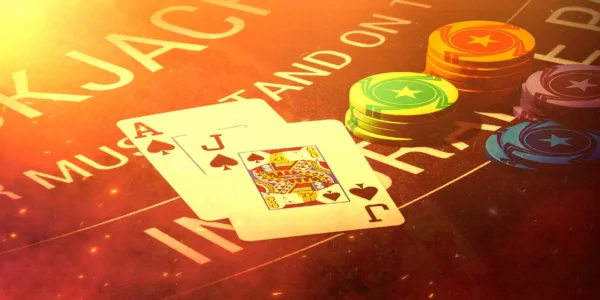
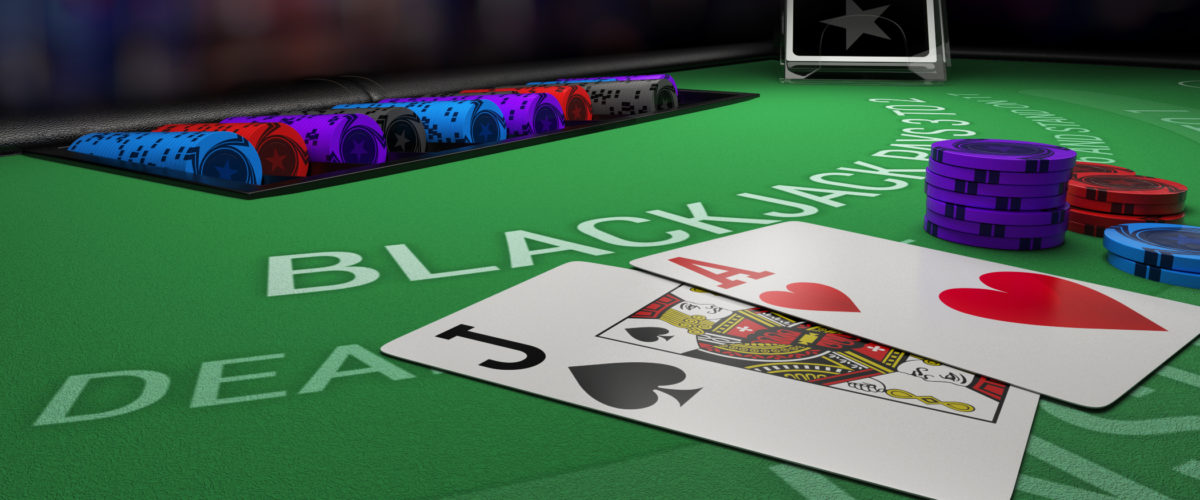
The game wasn’t an instant hit in America, however. In its early form, it wasn’t that exciting to players who were stuck in their ways and preferred to play the games of the time. To combat this, casinos decided to introduce promotional payouts, including the now-famous 10:1 bonus for a hand made up of the Ace of Spades and a black Jack. This promotional twist did more than just persuade people to try it out; it gave it the name blackjack, which stuck even after the promo was phased out.
Blackjack Takes the Spotlight
By the early 20th century, blackjack had started to find its footing, particularly as gambling became more structured and state-regulated. The rise of regulated casino gaming in Nevada during the 1930s gave the game a more formal spotlight. Rules began to become more uniform, odds became more transparent, and casinos saw the value in offering a table game that was simple to learn, fast to play, but still filled with drama.
As blackjack evolved, it retained its main appeal — a balance of luck and skill. Unlike many other games of the time, it offered players the chance to influence outcomes through decisions like when to hit, stand, or double down. This made it uniquely appealing to mathematically minded players hoping to use their intelligence to get an edge.
By the mid-20th century, blackjack had well and truly established itself in casinos across Europe, America and beyond. But the game still had plenty of evolving to do, and with the gambling boom of the 1950s, blackjack also saw a further rise. It was no longer just a game; it became a cultural symbol.

Blackjack and the Rise of Las Vegas
The story of blackjack took a dramatic turn in the mid-20th century, when it became a staple of the newly glamorised casino culture of Las Vegas. The 50s and 60s ushered in the golden age for casinos, and blackjack quickly rose to the top of the card game hierarchy. What helped set it apart from other games wasn’t just because the rules were simple to understand, but because players could increase the difficulty by using specific strategies, some more complex than others.
Unlike traditional slots, where the outcomes were totally random, blackjack offered more flexibility. Players could choose how they wanted to play their hand, decide whether to take a risk or play it safe, socialise with other players and interact with a dealer who felt more like an opponent.
The Card Counter Clampdown
As blackjack got more popular, the need for standardising rules and payouts became more important. Casinos began to implement things like multiple decks, automatic shufflers, and clearly defined dealer hit or stand policies. These changes were partly designed to stop the players getting an advantage over the house, as well as making games more fair across different tables and venues.
Around the same time, blackjack saw an unexpected cultural shift after Edward O. Thorp’s 1962 bestseller, Beat the Dealer, hit shelves. It introduced card counting to a mainstream audience, and for the first time, people saw blackjack not just as a game of luck, but one where a bit of brain power could give them an advantage. While casinos quickly fixed this by altering payout ratios and shuffling decks more frequently, the idea that a good strategy could affect the outcome continued on. Just as blackjack appeared to have reached its peak maturity, a new revolution, that was changing the entire world, evolved the game even further. The green felt tables were digitised into code, pixels, and, eventually, the live dealer games that are hosted on PokerStars today.
Blackjack Fun Fact
After Beat the Dealer made card counting famous in the 60s, some Las Vegas casinos changed blackjack rules to discourage the more skilled players. They introduced things like early reshuffling and restricted doubling, but this didn’t go down well with regular players. The backlash was strong enough that many casinos quickly went back to the more player-friendly rules.
How Online Blackjack Emerged
The rise of the internet in the 1990s ushered in a wave of change that touched nearly every aspect of daily life, including how casino games were enjoyed. It really didn’t take long for online casino platforms to appear, and while virtual slot machines led the charge with their eye-catching visuals and quick gameplay, blackjack presented an issue to developers – how could they mirror the realism and trust of a live dealer game in a purely digital environment?
The first generation of online blackjack games was modest, to say the least. Graphics did the job, but were flat and boring, while dealers were replaced by simple animations, and the gameplay, while accurate and true to rules, lacked the social aspect that partly made the game so popular in the first place. But even in this basic form, the convenience attracted players wanting to play from the comfort of their home.
As broadband internet became more widely available and as digital tech continued to improve, online blackjack quickly evolved. Real-money play became more trustworthy, and players wanted to see it mirror the same experience of land-based casinos with more authenticity, variety, and visuals.
This is where online blackjack casinos, like PokerStars, raised the bar and put a focus on offering players immersive gameplay, smooth performance, and designs that find the right mix of traditional gameplay and modern aesthetics. Soon after, the next big leap came along — live dealer blackjack.
The Game Changer – Live Dealer Blackjack
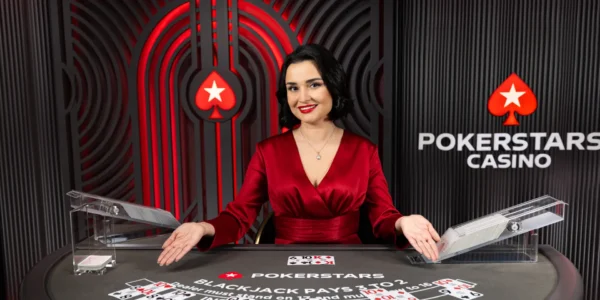
By streaming professional dealers in real time from high-quality studios, platforms like PokerStars could recreate the feeling of sitting at a real table complete with dealer interaction, visible cards, and a community feel. It brought back much of the human element that early online versions just couldn’t provide, all while keeping the convenience of playing through a screen.
Today, online blackjack is anything but a one-size-fits-all format. Players can choose from traditional RNG-based blackjack, like Classic Blackjack, where games move quickly and can be paused at any time, or join a Live Blackjack format that offers different stakes, rules, and side bets.
Key Differences Between Land-Based and Online Play
Blackjack hasn’t changed much in terms of rules, but where it’s played has evolved in some interesting ways. Whether at a traditional casino table or online, the feel of the game can shift significantly depending on the setting.
Atmosphere and Setting
Brick-and-mortar blackjack is rooted in social interactions and is one of the main reasons it’s never lost popularity. The energy of the casino floor, the ambient noise and music, the dealer’s banter and the physical act of placing chips down all add to the experience.
Online blackjack, on the other hand, offers a different kind of immersion. It’s sleeker, more accessible, and free from distractions. The aesthetics are crisp, the interfaces are intuitive, and the pace is up to the player. Whether playing at a computer or on a smartphone, an online casino can be personalised to the style and preferences of the player.
Live Blackjack options bridge the gap between the two types of venues. With real dealers on real tables streamed directly to a player’s device, they can enjoy a lot of the social and visual atmosphere of a casino, especially now that professional studios and high-quality streams have become the standard.

Gameplay Pace and Variants
Online blackjack tends to be faster. Without the need for physical dealing or player hesitations, hands can be resolved way more quickly. This makes it ideal for short sessions or for those wanting to practise or work on a strategy. PokerStars also offers various blackjack formats that go beyond what’s usually offered at land-based casinos.
For example, PokerStars’ Live Mega Fire Blaze Blackjack has an added bonus mechanic that kicks in based on what cards the player has in their hand. If their starting hand totals 14, it adds points toward triggering the bonus round. Points can also be earned when the dealer shows certain cards, like an Ace, or when they draw multiple cards to complete a hand.
Once five points are collected, the Fire Blaze Bonus Round starts. This introduces a separate 6×3 grid with three spins to drop multipliers. Each time a multiplier lands, the spin count resets. Fill a 2×3 block, and it gets enhanced with even bigger multipliers, which can give boosts of x10, x20, x50, or x100.
Strategy Changes
With the tools implemented into online titles, like hand history, game replays and adjustable bet limits, online blackjack can offer more focused and strategic play. These let players test different techniques or track outcomes in a way that’s far more difficult at a physical table.
That said, some players thrive in the high-stakes, real-time decision-making environment of live casinos. Seeing the faces of others, looking out for dealer tells, and being physically there all add to the psychological side of blackjack.
Multi-Hand Play
One of the biggest bonuses of online blackjack is the ability to play several hands at the same time. In land-based casinos, players can typically only have one hand per round unless extra seats are available or special game rules allow more.
Players can play with two, three, or even more hands at once, depending on the format. This opens up a lot more opportunities when it comes to strategy and offers faster gameplay. This is ideal for those who want more action or simply want to practise.

What’s the Future of Blackjack
The evolution of blackjack is far from over, and as technology continues to advance, it’s only a matter of time before blackjack sees its next phase that could completely redefine how the game is played and enjoyed for years to come.
Augmented Reality
AR could bring a new level of realism to online blackjack. For example, a virtual table could be projected right onto a table at home, complete with animated chips and a live dealer, all viewed through a pair of smart glasses or another AR-enabled device. This would further bridge the gap between physical and online casinos, making the experience as immersive as ever.
Artificial Intelligence
AI is another area set to reshape the blackjack experience. Rather than changing the rules, AI could personalise gameplay in subtle, player-friendly ways. From suggesting table formats based on past preferences to adjusting game pace or theme for comfort, AI may help players feel more in control of their sessions. It could even be used to help people gamble responsibly, keeping track of game history, including wins and losses, and letting them know when their plays begin to look unhealthy.
Virtual Reality
VR casinos are already in development, and blackjack is likely to be a key part of that. Future VR rooms could allow players to join live tables in fully 3D environments, choose their seat, handle virtual chips, and interact with dealers and other players in real time. Soon, the atmosphere of a land-based casino, including the ambient noise and flashy floors, could come to living rooms around the world.
Blackjack has come a long way from its European roots. What started as a simple card game has evolved into a cultural staple enjoyed across both land-based and digital platforms. While the format may differ, the heart of the game always remains the same – calculated risk and making decisions in the hopes of hitting 21.
FAQs
How old is blackjack?
What’s the difference between land-based and online blackjack?
Is online blackjack fair?
Can blackjack be played on mobile?
What is live blackjack?
Are there different blackjack games online?
Can card counting be used online?
Why is online blackjack popular?

Top Content


Trending