What is the Reverse Martingale Strategy in Roulette?
The Reverse Martingale Strategy (sometimes called the Paroli System) is believed to be the oldest roulette betting system in the world and still in use today in the age of the online casino, but what is it and how does it work? Well before we discover that, let’s take things from the top and learn more about the game itself shall we?
In-Depth Look into the History of the Spinning Wheel
The truth is, the actual origins of roulette are not fully known. As is the case with mysteries, many theories abound, and they are linked with well-known ancient civilizations such as the Greeks, the Romans, and even the Chinese.
However, the most credible story behind the invention of the game of roulette lies with the mathematician Blaise Pascal, who has been mentioned previously. Pascal was trying to create a machine that would be in perpetual motion but, sadly, failed dismally due to the law of thermodynamics. Although Pascal knew this, he still gave it his best college try, which was a blessing for gamblers around the world, as his failure gave birth to the first-ever roulette wheel.

From Failure to Casino Game Success
Yet another unfortunate instance in the history of roulette occurred, as Pascal never got to see his invention used for what it is so well-known for today. Forty years after he died, a wheel very similar to the one he invented was thought to have been used in an Italian game called Cavaglone, or Biribi.
This Genoese game could be compared to our modern-day Bingo, except that players would randomly choose cards that were numbered from 1-70. The banker would then pull a number out of a bag, and whoever picked that number was the winner. The story goes that the wheel eventually became a substitute for the banker, where it would be spun and a ball would land in a random slot, thereby making it much closer to modern-day roulette.
Sometime between 1710 and 1720, the game of Cavaglone went to France and became incredibly popular among the aristocracy. Renowned games historian Thierry Depaulis first mentions roulette in 1719. However, it is important to note that the word roulette is first mentioned in France in a legal document in 1711, and the word is even much older than that. It is descended from an Old French word, roulette, meaning “little wheel,” so it’s still impossible to pin down exactly when it travelled to France.
Roulette’s Rise and Fall

There may be uncertainty when it comes to Roulette’s origins, but game historians are certain that by the 1790s, the game had its own set of modern rules. Author Jacques Lablee mentions the roulette wheel being used in Paris in his book on the games, which was written in 1796 but only published in 1801. It describes the wheel as having both the zero and double zero slots, which is interesting considering the double zero is now most associated with American roulette.
Roulette was immensely popular from as early as 1711 when Bordeaux officers responded to complaints about swearing, scandal, and noises that surrounded the playing of this game. France finally implemented strict gambling regulations, and it was forbidden to play roulette as of 18 April 1741.
Growth of Roulette
Despite the prohibitions, the game grew and spread, as it became impossible to track and fine the long list of gamblers across France. The main perpetrators were French brothers Louis and François Blanc. They operated many illegal casinos in Marseilles and were very successful- until they were caught.
The laws at the time, however, had never tried a case like this before, so they ended up being released and moving to Luxembourg and then to the German state of Bad Homburg. Here, the brothers had been given free rein to operate their casinos by the local monarch as a way to climb out of the town’s huge debt issue. While doing this, Louis and François eventually created a new variant of roulette with a single zero slot, and it became the popular and most-played version roulette- European version we know today.

The Blanc brothers were soon known far and wide as the operators of some of the most successful casinos in all of Europe, and eventually caught the attention of Charles III, the prince of Monaco. The country was in a state of massive decline and was in so much debt that it was nearly impossible to climb out of it.
The solution presented itself to his mother, Princess Caroline after a brief visit to Bad Homburg. She suggested that Monaco legalise and get the Blanc brothers to open up establishments across the country. It was initially met with resistance from both of them, however, after Frankfurt abolished gambling, they reconsidered and shifted their entire operation to Monaco. As it is now one of the leading European gambling destinations in the world, you can easily say that the rest is history.
Roulette Strategies – The Reverse Martingale
Over the years since, many people have developed different systems and strategies to use while they play. The Reverse Martingale Strategy is one of several that works with even money bets like red/black and odds/evens.
As the name suggests, this system is the reverse of the standard Martingale Strategy which calls for you to double your wager after each loss. In this one, you do the opposite, and double your bet after a win. When you lose, you restart from the beginning.
Here’s an example:
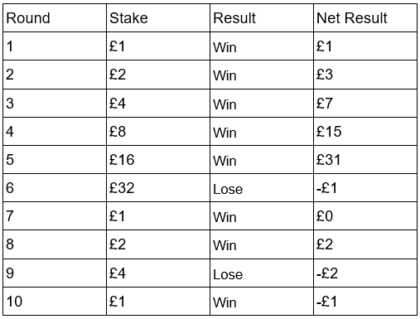
As with any betting system or strategy, there are no guarantees with the Reverse Martingale, but it can be a good way to manage your gaming session.
Roulette’s Future
The popularity of roulette started when it was first formalised in casinos and salons and has not stopped since. In fact, it is doubtful it ever will, especially with the many variants now available at online casinos.
It all started with Pascal’s need to disprove the laws of physics, but instead, his failed invention turned out to be a catalyst for a casino game that has endured for hundreds of years. It has withstood travels all across the globe, as well as legislation that outright banned it. Yet still, roulette stayed the course. The wheel has also changed and evolved, and, as the game travelled, strategies have emerged that give players some advantage. It is important, however, to remember that this casino game really comes down to luck and the spin of a wheel.
Related Roulette Articles




Top Content

Trending