How to hold your nerve and cross the finish line in poker tournaments

Holding the chip lead deep in a poker tournament is the dream scenario, but having the largest stack doesn’t mean an easy road to victory.
While you don’t need to worry about busting right now, being chip leader presents its own set of challenges. You know you should keep up the aggression, but how much? You know you should put pressure on opponents, but when’s the right time? You know that even if you lose a pot, you’ll still have enough to work with, but can you handle a dip and avoid going on tilt?
To ride the lead all the way to the win, you’ve got to pick your spots, remain calm, and stay focused.
That’s exactly what we see in the fourth and final episode of Between the Lines, a video series from PokerStars and Oracle Red Bull Racing (ORBR) that puts you in the driving seat and takes you behind the scenes with the biggest stars of F1 and poker.
Max Verstappen is dominating on the track in Hungary, while Michel Dattani is chip-leading the PCA Main Event in the Bahamas. Both lead throughout, anticipating their challengers’ strategies and disrupting them at every turn. All they must do is hold their nerve to the finish line…
But how do you maintain a chip lead and remain composed en route to victory?
CHIP LEADING TO VICTORY
We’ve seen many dominating performances over the years, where players grasp the chip lead and don’t let go until all the chips are in front of them. Some begin midway through a tournament, while others far later in proceedings.
Jamie Gold’s victory in the 2006 World Series of Poker Main Event is one of the most famous examples. Gold, who became known for his table talk that would put his opponents off balance, took a significant chip lead on Day 4 and maintained it over five more days to win $12 million (the largest Main Event prize until 2023’s surpassed it).
As for the late stages of a tournament, Sam Greenwood’s performance in the PCA 2019 $100K Super High Roller springs to mind. He didn’t enter the final table as chip leader, but once he grasped it, he never let go until the trophy (and $1.77 million) were his.
Then there’s Dattani’s PCA 2023 Main Event, highlighted in episode 4 of Between the Lines. Dattani entered the final six fourth in chips and didn’t become chip leader until they were three-handed. But the job was far from done.
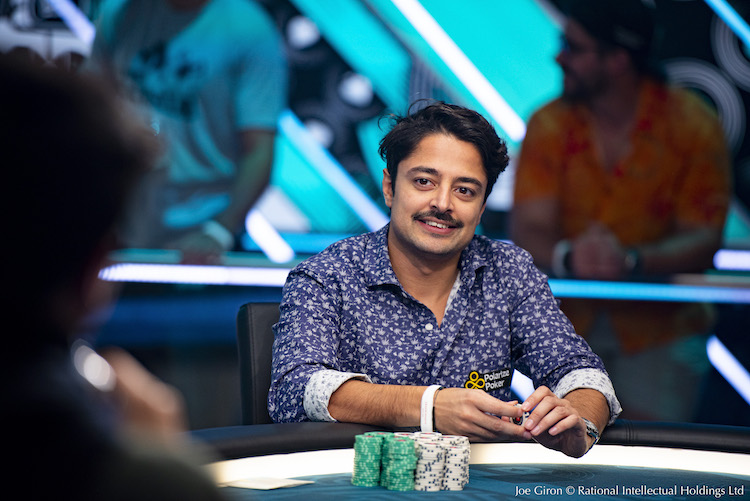
PCA Champion Michel Dattani
“Dattani was calm and composed, and ruthless in turning his moments of good fortune into an enormous payday,” we wrote when the tournament ended. “He was also brilliantly able to wriggle out of any tight spots in which he found himself, and ended up winning.”
FROM STRENGTH TO STRENGTH
So, how do you capitalise on having the biggest stack on the table, or in the tournament?
For starters, you should look for ways to capitalise on the pressure you can place on your opponents, such as the money bubble or pay jumps.
In this article, PokerStars Learn’s Dave Roemer highlights why the bubble provides opportunities for bigger stacks to accumulate chips without necessarily needing good cards. “This is easily accomplished by attacking players who seem to be desperately waiting for that bubble to burst to secure that payout before putting their tournament life on the line,” he writes.
“Playing on the bubble as a big stack is fun. You get to bully. You get to accumulate chips from players who are reluctant to miss the money. You know how irritating it is when the big stack is just hammering away on the bubble… when it’s your turn to be that player, take advantage of it and enjoy.”
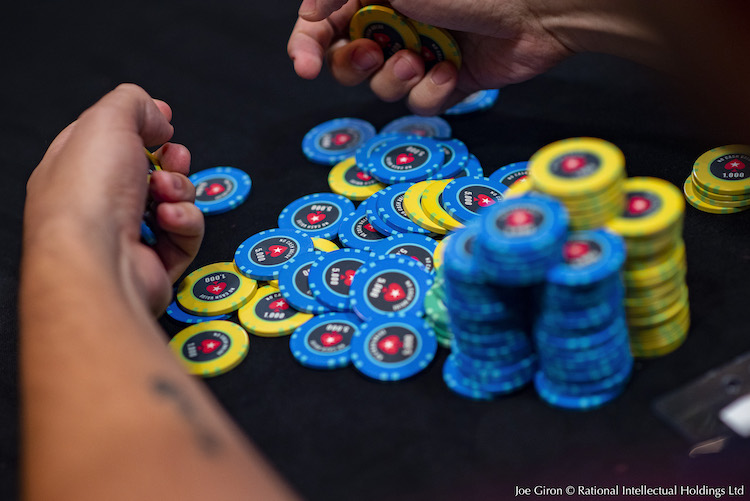
It’s fun to be a big stack
But you should also be cautious of playing too aggressively, particularly against other big stacks that could put a major dent in your chip count. You won’t often see two huge stacks battle on a money bubble, so when this happens, tread lightly. There’s a good chance your opponent has a very strong hand.
Likewise, you don’t want to get caught bluffing but be priced in and forced to call the all-ins of short stacks when you have mediocre hands. You might be able to withstand this scenario a couple of times, but if it happens repeatedly your stack will take a major hit.
“Just don’t forget to take your foot off the gas when the bubble bursts, as those frustrated short and medium stacks are no longer going to have the pressure on them they just did.”
APPLY AND AVOID PRESSURE
When you’re deep stacked, you can apply pressure on shorter stacks. However, other big stacks can also apply pressure on you.
Savvy players know you won’t want to relinquish your big stack and might try to take exploit this by playing aggressively against you. So, just because you have lots of chips, it doesn’t mean you can play carefree.
Here’s an article highlighting how you can apply pressure while also avoiding pressure when deep stacked.
One way to do this – particularly when battling other big stacks – is to exercise pot control. In other words, you don’t let the pot swell up to the point where winning or losing it will have a huge impact on the rest of your tournament.
“Building the pot is often necessary and usually fun, but sometimes it is important to keep the bet and raise buttons on ice,” writes PokerStars Learn’s Pete Clarke. “Pot Control is the art of keeping the pot manageable when you have a hand that cannot gain from betting or raising. Accurately detecting when you need to do this is what separates strong, selectively aggressive players from weaker, mindlessly aggressive ones.”
Find out how to master pot control here.
HOLDING YOUR NERVE
Believe it or not, even chip leaders and big stacks can find themselves going on tilt when they lose pots, even if they’re still left with plenty of chips.
It happens when you lose a pot and see your chip stack take a hit. You then struggle with the fact your stack isn’t as big as it once was, so you begin to play badly in an attempt to win those chips back and return your stack to its former glory.
This falls under the ‘Desperation Tilt’ banner, one of the seven types of tilt laid out by mental coach Jared Tendler in the Mental Game of Poker.
The urge to win back your money (or pride) can cause you to make all kinds of mistakes. This can translate to forcing the action, making huge bets, and angrily shoving all in with nothing.
Unless you’re sun running, it’s very likely you’ll take some beats as a big stack. It’s how you handle them that will determine whether you can hold your nerve and go all the way.
Learn more about the effects of tilt – and how to avoid it – here.
MORE ABOUT BETWEEN THE LINES
WATCH ON YOUTUBE
HOW TO USE AGGRESSION IN POKER
HOW TO MAKE COMEBACKS IN POKER
HOW TO STAY PATIENT IN POKER

Latest Articles






View Other Blogs